Showing posts with label fauna and flora. Show all posts

Sunday, September 28, 2025

Quote of the Day


“How beautifully leaves grow old. 

How full of light and color are their last days.” 

- John Burroughs

Image by Dominique Allmon©2025

Thursday, May 1, 2025

The Joy of Gardening or How to Mend a Broken Heart

Bio-dynamically grown cucumbers by Dominique Allmon

"Gardening is cheaper than therapy and you get tomatoes." – Unknown

Unless you lost a loved one you will never understand the avalanche of emotions that overwhelms the minds, the hearts and the souls of those bereaved.

I lost my husband in December 2023, short before Christmas. I lost the love of my life, my best friend, my companion, my twin soul, my alter ego. I lost my home, my garden, my dogs and my cats. My husband's spiteful daughter told me that "now, that my husband was dead, I could finally go back to my life". I wish I could "go back" to my life. I wish I could return to the time long before Jim's cancer diagnosis, when life was good and dreams were still possible.

One of the most important things in life is to never define yourself or your happiness by your possessions or the people in your life. You should be able to be happy even if you lost everything. I always understood that happiness was an inside job but I never imagined how I would cope with the loss if it actually happened in my life.

When you and your spouse are so completely connected that you become one mind, one soul, a sudden loss of your "other half" leaves an incredible emptiness. Nothing in your life prepares you for such a tragedy. Your world is completely shattered in an instant. You cannot "return to your life" and you don't simply move on. You survive and if you are lucky, you will slowly learn how to live again.

My husband's 2021 stage IV renal cell carcinoma diagnosis came as a shock to both of us. We hoped that he would be able to beat the disease, but we also knew that our days together were somewhat numbered. Still, his passing in December 2023 came unexpectedly. Five months later, one of our puppies died in the custody of my husband's daughter. An unimaginable void opened after these two deaths and unbearable pain became my companion ever since.

Interaction with my late husband's daughter in the weeks that followed his passing put me into an acute PTSD setting and left me heartbroken and traumatized. Although my husband left me everything he had, in a moment of distress and confusion, I renounced my inheritance believing that his daughter and her big family would have a better use for it. Despite my generosity I was even threatened with physical violence if I were to say something bad about my husband. Suddenly, I had to face evil I was not prepared for. Moreover, because of a nasty trick I lost my husband twice. Lies, deception, fraud, more lies.  

Till today I cannot understand how my sweet husband could have even been related to a person without honor, conscience or decency. If he had witnessed what transpired after his death, he would have been angry and disappointed. He would have never allowed this to happen, but that's a material for a book that probably will never be written.

Dealing with the loss of your loved one takes up all your energy, but to deal with pure, premeditated evil at the same time when you didn't even know it existed, adds another dimension to you suffering. 

I do understand that she lost her beloved father and took out her anger and frustration on me without even considering that I myself was grieving and in pain. I had nobody to turn to, just myself all alone. 

My favorite tea cup 

We all have our big and small tragedies and I am aware that nobody cares about my story. However, if you are broke, broken and depressed like me or feel stuck in your current emotional state for any reason, you may want to try something different for a change if you do not want to see a therapist. 

Healing takes time and requires a lot of strength if one doesn't want to lose one's mind or drown in anger, resentment and self pity. Some things cannot ever be repaired. You will never be the same. You do not move on. You cannot really recover from your loss. The grief will never go away. All you can do is to learn to cope, accept the things the way they are and try to somehow mend the broken heart, if this is even possible.

Grief is not a linear process. It is not a problem to be solved. Everyone experiences it differently. The grief will turn your life upside down and if you truly loved someone you lost, the grief will never leave you. 

The extreme emotional pain you feel after the loss of a loved one can profoundly affect your emotional and physical health. Finding something that will give you sense of purpose and accomplishment could help during the time of grief.

Fire beans in bloom by Dominique Allmon@2024

Gardening seems like one such thing that could help a grieving person to deal with the avalanche of emotions. It is an active exercise in mindfulness. It requires willingness to learn, concentration and many hours of work every day. Getting your fingers dirty is actually healthy and quite relaxing. Spending a lot of time outside and watching the plants you planted grow and move through their cycles of life can help you take your mind off your pain and connect with nature in a most healing way. You not only observe the cycles of life but also learn to accept the impermanence of things. 

There is an amazing sense of grace to be found in gardening...  

Many stressed or distressed people believe that there is no better way to calm the nerves and stimulate one's creativity than digging in the dirt and planting seeds. In fact, serious scientific studies were conducted on the relationship between mental and physical health and gardening. 
 
Scientists found out that gardening 
  • helps you stay physically and mentally active 
  • improves physical agility and helps strengthen the muscles
  • exposure to sunlight while gardening helps you boost your Vitamin D levels
  • possibly boosts immunity since the soil contains microorganisms beneficial to the immune system 
  • decreases risk of such chronic diseases as heart disease and old age diabetes
  • improves cognitive health and keeps your mind sharp
  • gives you sense of purpose and accomplishment
  • brings joy and happiness to your life 
  • reduces stress and anxiety 
  • helps you relax and sleep better
 
And, of course, if you are growing vegetables in your garden, gardening improves the way you eat since there is nothing more delicious than freshly plucked tomato or cucumber that you planted and have seen growing. 
 
Gardening can be very rewarding. Naturally, no amount of gardening will ever take your pain away, but it may help you manage stress and depression, if only just a bit. It helps you cope with difficult emotions. Daily work in the garden prevents you form losing your mind or turning bitter and vengeful. Your own joy and happiness is the best vengeance towards those who hurt you.
 
A friendly wasp by Dominique Allmon

I no longer have a large garden so I started a small, bio-dynamic one on my balcony. I no longer have cats or dogs so I make friends with bumble bees and wasps. I thank the bees for pollinating my plants. I thank the wasps for keeping my plants free from aphids and other vermin. Watching things grow in my garden gives me some joy and comfort while I am trying to sort through memories from a much happier time.

Growing, harvesting and cooking your own food is probably one of the most satisfying experiences any gardener can have.

Although I completely lost my appetite I know that being able to prepare a meal from the fruits of one's diligent labor is a vital element of self care and cannot be underestimated during the time of mourning. 

Most days are very difficult for me. I hardly sleep anymore and I could probably water my small garden with all the tears I am shedding. I know that my beloved husband would not want me to let myself go so I try to pull myself together. Watching things grow fills my heart with gratitude. I take my morning coffee and read books in my garden just like we both used to do on so many mornings. I harvest my vegetables and prepare my meals the way I did for both of us. I don't even need to close my eyes to see my husband's smile as he is waiting for the salad dressing I am making.

We promised each other to be together forever. He never left. He just moved to another plane of existence and is waiting there for me...

By Dominique Allmon

In loving memory of my husband James W. Allmon (1953-2023)

Post scriptum

Cancer seems to be a nightmare my husband's family has to deal with. On May 7, 2025 my husband's son James William Jr. passed away only two moths before his 50th birthday. May he too rest in peace. 

Dominique Allmon©2025

Wednesday, March 12, 2025

Bluebonnet


Bluebonnet, bluebonnet, blooming anew
Proudly and loudly, your entrance you make,
Infant of nature asplash in the dew.

- from a poem "Dayspring Bluebonnet" by Alan S Jeeves

Image: Fragment of the painting "Early Spring - Bluebonnets and Mesquite" by Julian Onderdonk, 1919

Poem source here 

Friday, May 19, 2023

Happy World Bee Day

Visiting Bee by Dominique Allmon©2023
 

Where there are bees there are flowers, 

and wherever there are flowers 

there is new life and hope. 

- Christy Lefteri in "The Beekeeper of Aleppo"


In 2018 the United Nations Organization declared May 20th the World Bee Day to acknowledge the role bees play in our ecosystem, and to raise awareness about the declining pollinating insects populations and the need to support and protect them.

Promote biodiversity. Start a garden. Plant flowers, flowering herbs and shrubs everywhere you can! 


Visiting Bee by Dominique Allmon©2023

Images: Visiting Bees by Dominique Allmon©2023

World Bee Day

Friday, March 10, 2023

Nature Waking Up in March

Image: Nature Waking Up in March  by Dominique Teng©2023 
 
 “By March, the worst of the winter would be over. 
The snow would thaw, the rivers begin to run 
and the world would wake into itself again.” 
 
- Neil Gaiman
 
Image: Nature Waking Up in March by Dominique Teng©2023

Tuesday, July 26, 2016

Magical Rose Garden

Wild Rose by Dominique Allmon©2016
One of the most tragic things I know about human nature is that all of us tend to put off living. We are all dreaming of some magical rose garden over the horizon instead of enjoying the roses that are blooming outside our windows today. - Dale Carnegie

Friday, December 5, 2014

Wolves - The Endangered Species


A letter to the editor of the Idaho Mountain Express

Humans have damaged wildlife more than wolves! 

Wolves are effective predators, but I am not sure why people insist on calling them “vicious.” With only teeth and fast strong bodies they hunt to live - that’s their role. 

They do not extirpate their prey. When researchers follow wolves, they find their success rate is usually less than 20 percent. That means the prey are not at all defenseless: their fast, strong bodies save them more than 80 percent of the time. Given the opportunity, wolves will surplus kill, but research shows us that they will go back to the site of surplus kills for months and feed. Assuming, of course, that people don’t lay in wait, to shoot, trap or poison at these sites. 

What puzzles me most of all is why we condemn the behavior in wolves that we, ourselves, engage in. We are outraged when a wolf “tears apart” a mother elk, but in a few months it is fine for us to go shoot the mother. Is it the “neatness” that makes it OK? We object to the “violence” of wolves against our livestock, but send the same livestock to premature violent and untimely deaths. To ask wolves to have a conscience is silly. They are wild animals. They are not supposed to have a conscience. That is a human trait. We humans are by far the worse in comparison: we do have a conscience, yet revel in the (often cruel) splintering and annihilation of wolf families. 

We nearly extirpated both elk and bison. We dare to think we are the only capable wildlife managers, refusing to admit that nature, before we came, was doing just fine. Once there were teeming herds of elk, bison and other game, living just fine with an estimated two million wolves. Why do you think it’s the wolves causing the problem?
 
By Chris Albert 

* * *
 
 
"The wolf is one of the wildest and shyest of all the animals in the northern wilderness." - after David Mech
 
Wolves are amazing creatures. They form social structures that could make any modern family blush. The Alpha male enters a lifelong, monogamous bond with the Alpha female of the pack. Wolves love wolf babies. The Beta male is responsible for the welfare of the little ones, but the whole pack plays with them and is very protective. There are friendships and there are fights within a pack, but even the weakest of all, the Omega wolf, is taken care of if he is in need. 

Wolves are very territorial species and they will protect their territory from other wolf packs. They are predators. They kill big game and sometimes cattle, but seldom attack people. However, they kill to survive and not, as it is wrongly believed, out of pleasure of killing.

In 2013 grey wolves were taken off the list of protected species in the USA. Hunters can now organize barbaric hunting rallies. They are permitted to use tracking dogs and kill wolves from helicopters. They have the permit to kill not only the magnificent grey wolves, but also the endangered and extremely rare Mexican red wolves. The plea of the conservationists and the nature lovers is ignored by the authorities in most States where wolf hunting is allowed. 

The subject is quite delicate. It is believed that hunters play important role in nature and I can understand hunting for food, but the "recreational" killing of animals is bare of any ethics. 

The argument that wolves decimate herds is a very weak one. In Poland, where wolves are protected species, the government reimburses farmers for their losses. Why this could not be done in one of the richest countries in the world is puzzling to me. 

By Dominique Allmon

For centuries wolves have been characterized as bloodthirsty beasts and the bane of helpless livestock. Determined to overcome this misconception, film makers Jamie and Jim Dutcher, the creators of the Emmy Award Winning "Wolves at Our Door" documentary spent six years in a tented camp in the wilderness of Idaho living with a pack of wolves. Please watch and share this amazing documentary. It is quite eye-opening.


Also of interest: The Wolf Man -The Diary of Paul Balenovic and A Man Among Wolves

Image source here

Monday, August 18, 2014

Hydrangea


Blue Hydrangea by Dominique Allmon©2014


~ Hydrangea ~

by Rosanna Warren

From the bottom of the garden, enthroned in his earthenware pot,
the hydrangea god surveys his minions -            
lavender agapanthuses bowing starburst heads,
red bignonia calyxes trumpeting his fame,
oleander leaves whispering of his misdeeds.
The central path leads straight to him. Behind,
a stained mirror and mossy wall back up his power.
Thousands of crinkled, tiny, white ideas occur to him
with frilled and overlapping edges. No one else
deploys such Byzantine metaphysics. No one
can read his mind. Only he remembers
the children's secret fort by the cypress tree
among fraught weeds, rusted buckets, and dumped ash,
and how lost the grown-ups sounded, calling, as night came.


Poem source here

Friday, April 25, 2014

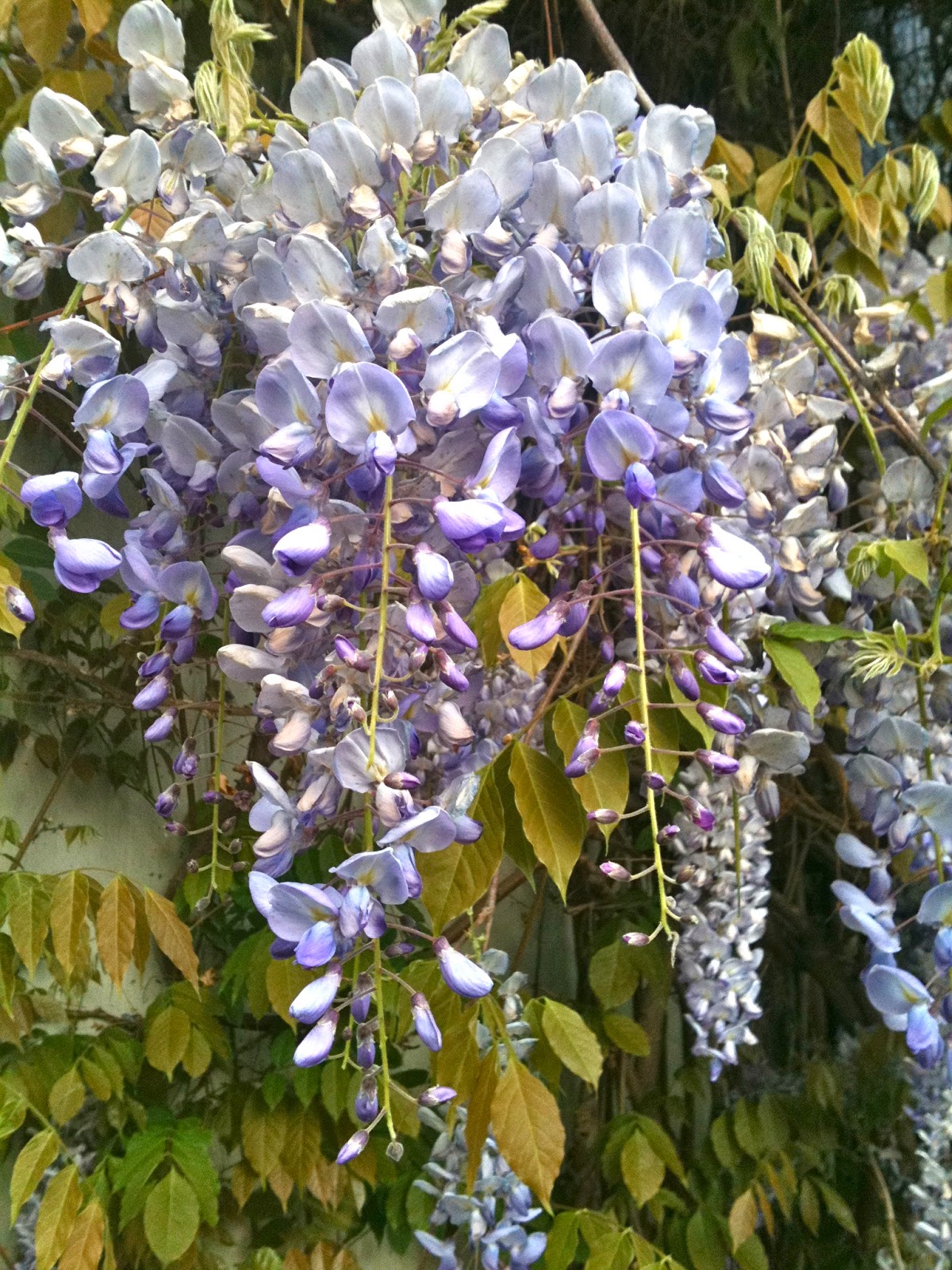
Wisteria Into Spring


Upon opening the curtains
To welcome the day
You were standing there
Your head hung low
Your endless array of purple
Clinging to your slender
limbs

You waved as the gentle breeze
Blew your delicate fragrance
My way
I love spring when you are in
Full bloom
My beautiful magical plant
Wisteria.

By Australian Poet
Thelma Elisabeth Zaracostas 


Tuesday, August 6, 2013

Honeybees


I’ve felt myself changed simply walking 
into shade along a street; I’ve come suddenly 
upon the scent of snapdragon or heard 
a distant car crash and found my every thought 
stalled at the gate.  And when I read 
that honeybees are dying in thousands, 
an epidemic no one can explain, I wondered, 
Have I forgotten something?  Who am I now? 
There are theories, there are whole histories passing away, 
but I can’t describe them.  So, from the next table, 
bits of conversation break into my soliloquy 
or my neighbor’s phone rings through the walls 
and I join a dialogue with a stranger.  To call any of it 
a change of scenery or costume is to misunderstand. 
The world is not a stage and the honeybee 
is not the soul it once symbolized.  This is why 
I’m fascinated by bricked-in windows, 
old tenement buildings throughout Jersey City 
with their view closed up, so I daydream 
about who, on a hot summer day, leaned on that sill 
breathing in the confusion of car fumes and flowers, 
himself daydreaming until his elbows ached 
and he remembered there was a clogged drain 
in the bathroom and he turned back, 
pausing for his eyes to adjust to the dark room.

By Michael T. Young 


First published in The Louisville Review, No. 68


To visit Mr. Young's website please click here
Image source here

Sunday, January 13, 2013

Why Evolution Is True


Among the wonders that science has uncovered about the universe, no subject has sparked more fascination and fury than evolution. Yet in all the ongoing debates about creationism and its descendant, "intelligent design," one element of the controversy is rarely mentioned: the evidence, the empirical truth of evolution by natural selection. And that evidence is vast, varied, and magnificent, drawn from a huge spectrum of scientific inquiry ranging from genetics, anatomy, and molecular biology to paleontology and geology.

"Why Evolution Is True" is a succinct and accessible summary of the facts supporting Darwinian evolution. Scientists today are finding species splitting in two, observing natural selection changing animals and plants before our eyes, and discovering more and more fossils capturing change in the past - dinosaurs that have sprouted feathers, fish that have grown limbs. Jerry Coyne eloquently shows that evolution does not destroy the beauty of life but enhances it.

Reading this book will explain why so many scientists have dedicated their careers to resolving this debate, and why education administrators fervently fight legislation demanding that science curricula include equal time for anti-Darwinian theories. By demonstrating the "indelible stamp" of the processes first proposed by Darwin, Jerry Coyne clearly confirms that evolution is more than just a theory: it is a fact - a fact that cannot be doubted by anyone with an open mind. 

Sam Harris about the book:

Jerry Coyne has long been one of the world's most skillful defenders of evolutionary science in the face of religious obscurantism. In Why Evolution is True, he has produced an indispensable book: the single, accessible volume that makes the case for evolution. But Coyne has delivered much more than the latest volley in our "culture war"; he has given us an utterly fascinating, lucid, and beautifully written account of our place in the natural world. If you want to better understand your kinship with the rest of life, this book is the place to start.

About the author:

Jerry A. Coyne, Ph.D is a Professor in the Department of Ecology and Evolution at the University of Chicago and a member of both the Committee on Genetics and the Committee on Evolutionary Biology. He has written over 110 refereed scientific papers and 80 other articles, book reviews, and columns, as well as a scholarly book about his field - "Speciation" - co-authored with H. Allen Orr. He is a frequent contributor to The New Republic, The Times Literary Supplement, and other popular periodicals.


Article source here

Friday, August 17, 2012

Cabinet of Curiosities


Originally, a cabinet of curiosities, also known as a cabinet of wonders or the Wnderkammer, was an intricate piece of furniture designed in Italy during the Renaissance for storing and display of rare and precious objects.


By the 17th century, a cabinet of curiosities had evolved into a room within a house in which ever growing private collections of curios and oddities were displayed.


Keeping in par with the developments in natural sciences, men of social distinction began collecting prints, ancient manuscripts, fossils, rocks, shells, feathers, insects, taxidermied animals, antlers, and preserved specimen with congenital deformities or the wax models of such. 


Such eclectic collections bore testimony to a slightly morbid fascination with the bizarre, but they were also a proof of man's growing desire to better understand the physical world that surrounded him. They seemed to satisfy his hunger for knowledge and the need to explore the world.


This almost puerile curiosity was paired with a compulsion to gather the most unique or exotic specimen and gave birth to an entire industry. Not only the adequate display cases had to be made, but the specimen had to be collected and preserved. Those who could not travel to far away places had to resort to other means. They purchased their treasures from antiquaries and curio shops.


With time, these collections grew in size and complexity and began losing their randomness. They became invaluable precursors to a more elaborate enterprise, namely, the museum of natural history, where a thorough classification and systematization of specimen was taken into a new level after Charles Darwin presented his Theory of Evolution.

Institutions such as the Royal Society or the Smithsonian Institution promoted learning and intellectual curiosity and contributed greatly to a systematic research and collecting.


What began as a hobby of a few cultured and curious men was transformed into a scientific endeavor to mark humanity's  place on this planet and put it in a greater context of evolution.

By Dominique Allmon
 
Dominique Allmon©2012


Images source here

Friday, August 10, 2012

Ants and Other Great Medicines

 Cabinet of curiosities

Great Medicines is an unpublished book by Gary J. Lockart (1942-2001)

Introduction

The medicine of our ancestors was a wonderful mixture of trash and treasures. Most of it was imagination and superstition, but there were real discoveries as well. The twentieth century saw scientists delving into the molecular basis of life. In spite of all their discoveries, some of humanity’s basic medical conditions seemed to be almost hopeless. The newer doctors derided the practices of the past, for they believed that their answers were more scientific. 

We have forgotten the old medical secrets, and they have been nearly left out of medical history, but history should be studied. In an earlier era a prescription might read: “Rx: take two leeches, one spider and a dozen ants.” Now we are educated and we know these as relics of the past. Yet ants were once valued as a cure for arthritis. Spider venom holds promise as a cure for muscular dystrophy. Leeches are used in modern surgery for reattaching ears and fingers. 


Natural history print "Anthropodes"

Superstition is sometimes relative to our level of examination of it. In 1929 a Scottish bacteriologist wrote: “The penicillin molds are pleasant enough. We are content to use them to bring our Camembert and Roquefort cheeses into a pleasant condition of ripeness and in that respect I would not miss them. But beyond that and especially with a view to therapy in medicine, these molds are completely worthless.” Fifteen years later these molds were producing large quantities of penicillin, our first wonder drug! From Helmuth Bottcher’s "Wonder Drugs - A History of Antibiotics". 

In 1992 the Declaration of Helsinki of the World Medical Association read: “In the treatment of the sick person the physician must be free to use a new diagnostic and therapeutic measure, if in his or her judgement, it offers hope of saving life, re-establishing health or alleviating suffering.” The AMA signed this declaration. If we cannot cure people with operations and unaffordable medicines, we need to look at the past and see what others have used. 

The idea of wonder drugs permeates medicine today. I am told that a newly minted doctor has spent nearly a year of schooling memorizing thousands of drugs and their indications in order to give instant advice. Sir William Osler once wrote: “One of the first duties of the physician is to educate the masses not to take medicine. Remember how much you do not know. Do not put strange medicines into your patients.” 

Healing power exists in the mind and this is why much of ancient medicine worked. The modern placebo is an adaptation of an ancient practice of some type of visualization, the doing of which brings relief or healing. A second part of healing exists in stimulation of the body. This may be walking, exercise, or applied externally as in massage to stimulate the muscles and nerves. A third part of healing is in biochemically active compounds coming from plants, insects and nature. This area has received the most publicity. 

Paracelsus wrote: “The power of imagination is a great factor in medicine. It may produce diseases in man and in animals and it may cure them. But this is not done by the powers of symbols or characters made in wax or being written on paper, but by an imagination, which perfects the will. All the imagination of man comes from the heart. The heart is the seed of the microcosm, and from that seed the imagination proceeds into the macrocosm. Thus the imagination of man is a seed that becomes materialized or corporeal.” 

I began my study of medicine in 1976 as a quest for forgotten herbal remedies. As I worked my way through millions of pages of literature, I began to save odd notes. This book is a collection of these notes. Many items could be of value today, but most need the touch of modern science. This book is not written as a medical advice book, but as an exploration of history. In case of illness, see a qualified health practitioner. 

By Gary J. Lockart


This book is available online in a pdf format
Image source here and here

Wednesday, August 8, 2012

The Secret Path

 The secret path

Every time I have a chance, I take a walk in the woods. There is nothing more satisfying than a cool atmosphere of an old forest. The sounds and smells are unforgettable. To me they always seem familiar; a crack of dry twigs under the shoes, chirping of the birds in the distance, the scent of wild herbs mingling together with the unique green fragrance of ferns, moss and decaying wood. 

 Stinging nettles

Every forest seems both mysterious and familiar at the same time, and each time you come back, it seems as if it were altered by some magic. You never enter the same forest twice. Heraclitus might have thought of that...

Wild blackberries

For me a forest opens a door to childhood memories. There was not a single  Summer that we did not travel to a forest to hunt mushrooms or pick blueberries, blackberries and wild strawberries. My parents, who were big city folks, taught me all I needed to know about mushrooms, herbs and berries.  Although I have not applied this knowledge for a very long time, I never forgot what I learned as a child. And I would like to learn more!

 Rosa rugosa

A few days ago I had a chance to take a walk in a small forest. Naturally, I could not resist my old instinct to pick up something edible. I found ripe blackberries and stinging nettles. There even was a small bush of wild roses. I did not have a basket with me, so the booty wasn't large, but the entire experience was incredibly satisfying. I ate the berries and left the nettles and rose petals to dry in the sun. They will make a wonderful herbal tea.

The booty

When I think of it now, foraging seemed very natural when I was a child. I can imagine that those who did so as children would take every chance to forage in their later age.

In fact, the foraging as a movement is experiencing a comeback of sorts. Books are being published and the bloggosphere is full of information for those who wish to learn more about edible wild plants. 

The food is abundant out there. One simply has to stretch the hand out and pick what is growing freely on meadows, in the fields or in the forest. 

By Dominique Allmon
 
Dominique Allmon©2012

Friday, July 27, 2012

The Peacock

Remember that the most beautiful things in life are often the most useless. Peacocks and lilies, for instance. - John Ruskin, prominent English art critic of the Victorian era (8 February 1819 – 20 January 1900)


Image source here

Tuesday, July 24, 2012

Quote of the Day


Happiness is like a butterfly which, when pursued, is always beyond our grasp, but, if you will sit down quietly, may alight upon you. - Nathaniel Hawthorne


Thursday, July 19, 2012

Blue Butterfly

Morpho pleiedes
Morpho pleiedes

With wings spanning from three to eight inches, the blue Morpho pleiedes butterfly is one of the largest butterflies in the world. 

The brilliant blue color in its wings is caused by the diffraction of the light from millions of tiny scales on its wings. The iridescent color is used for protection in an amazing way. The butterflies stick together in groups to deter their predators. By rapidly flashing their wings, they drive the predators away. 

The underside of the morpho’s wings, on the other hand, is a rather dull, brown color with many "eye" spots. It provides a perfect camouflage against predators when its wings are closed. 

Morpho pleiedes is native to northern part of South America and can be found in Mexico, Paraguay and the rainforest of Central America. It feeds on the juices from rotting tropical fruits.

Sunday, April 29, 2012

Vanishing of the Bees

Eros, Venus and the Bees, Albrecht Dürer, 1514
 Eros, Venus and the Bees, Albrecht Dürer, 1514

The Documentary

Honeybees have been mysteriously disappearing across the planet, literally vanishing from their hives. Known as Colony Collapse Disorder, this phenomenon has brought beekeepers to crisis in an industry responsible for producing apples, broccoli, watermelon, onions, cherries and a hundred other fruits and vegetables. 

As with any great mystery, a number of theories have been posed, and many seem to researchers to be more science fiction than science. People have blamed genetically modified crops, cellular phone towers and high-voltage transmission lines for the disappearances.

"Vanishing of the Bees" documentary follows commercial beekeepers David Hackenberg and Dave Mendes as they strive to keep their bees healthy and fulfill pollination contracts across the U.S. The film explores the struggles they face as the two friends plead their case on Capital Hill and travel across the Pacific Ocean in the quest to protect their honeybees.

Documentary synopsis:
  • Honeybees are responsible for one-third of our food supply, yet they are disappearing at a startling rate in a phenomenon known as Colony Collapse Disorder, or CCD
  • The documentary “Vanishing of the Bees” takes a piercing investigative look at the economic, political and ecological implications of the worldwide disappearance of the honeybee
  • CCD is most likely the result of a constellation of factors, one of the largest being the growing contamination of their hives with pesticides, especially the newer systemic pesticides, or neonicotinoids
  • Bees appear to be suffering catastrophic effects after exposure to even low levels of certain pesticides, including inability to fight off infections, nervous system damage, disorientation and impaired navigation
  • Bees are increasingly being raised “factory farm” style with artificial food, artificial insemination, and grossly unnatural hive conditions that further stress the colony, highlighting an urgent need to return to more natural beekeeping traditions
Filming across the US, in Europe, Australia and Asia, this documentary examines the alarming disappearance of honeybees and the greater meaning it holds about the relationship between mankind and mother earth. As scientists puzzle over the cause, organic beekeepers indicate alternative reasons for this tragic loss. Conflicting options abound and after years of research, a definitive answer has not been found to this harrowing mystery.


Friday, April 6, 2012

Sakura - The Celebration of Nature

Sakura at Hirano Shrine, Kyoto

Japanese aesthetics evolved around nature and its cycles. And while Shintō considers nature to be sacred, the Buddhists in Japan celebrates its beauty and impermanence. 

Like no other natural "phenomenon" sakura holds great significance for the Japanese people. Sakura, or the cherry blossom, symbolizes new beginning. Its fleeting beauty invites to a reflection on the meaning of life. Everything changes, everything is in constant motion, nothing lasts forever. In order to fully appreciate life, one must be able to live in the moment. 

Sakura mochi

Since ancient times artists, poets, and philosophers celebrated this temporal beauty. Celebration of sakura in the early days of April is a perfect excuse for an outdoor gathering with family and friends. There is nothing better than a short escape from the monotony of everyday city life. You may even wonder whether it is the scent of sakura or too much sake under the sakura tree that makes people appear so carefree in a normally emotionally reserved society.

The beauty of sakura trees invites one to an intense contemplation. One not only takes time to appreciate the beauty of nature, but also learns to understand that all joys of life are temporary. As much as one would love to hold on to this tantalizing experience, one must let go. But there is no regret. One finds comfort in the very fact that nature follows its own cycle...

By Dominique Allmon
 
Sakura mochi image source here


Monday, February 13, 2012

The Beauty And The Rose

Rose - the queen of all flowers

Since ancient times rose has been a symbol of love, beauty, and sensuality. No other flower is so universally known and appreciated.

In ancient Egypt roses were considered to be sacred and were used in offerings to the goddess Isis. Remains of roses were found in Egyptian tombs were they were used as the funerary wreaths.

Cleopatra is believed to have perfumed the sails of her ship with rose water when she sailed to meet Marcus Antonius. The legend has it that the chamber of their first encounter was carpeted with rose petals. No wonder the Roman commander lost his mind.

In ancient Greece the rose was consecrated to the goddess of love Aphrodite. Romans continued this tradition and offered this lovely flower to Venus. The rose was omnipresent in ancient Rome. Rose water and rose oil were the symbols of luxury and were used to stimulate the senses during lavish banquets at the Roman court. The Patricians decorated their mansions with roses and wore rose garlands around their necks.

The flower was also used in Greece by the Eleusian Mystery schools. Temples were decorated with roses and the aspirants wore a rose before their initiation. The flower was to remind them of silence and secrecy they were sworn to. This tradition known as "sub rosa dictum" goes back to Alexandria and the Alexandrian hermetic tradition where rose was dedicated to Horus/Harpocrates, the god of silence.*

The rose as a symbol of silence was later adopted by the Rosicrucian Order and by the Freemasons. The adepts were sworn to secrecy and were not allowed to reveal any information about proceedings of the Orders.

Since the ancient times roses were valued for their medicinal properties. Roman historian and naturalist Pliny the Elder recorded thirty two conditions that could be relieved with roses. Rose petals, rose leaves, and rose hips were used internally and externally. Young rose buds were used in Traditional Chinese Medicine to promote the movement of the Qi energy within the body, to cure digestive disorders, and to alleviate gynecological disorders.

In Europe, a 12th century mystic Hildegard of Bingen used roses to heal the lepers. A century later, Crusaders returning from the Holy Land brought the Damascus rose to France. The species, Rosa gallica officinalis, also known as the  Apothecary's rose, was cultivated for medicinal purposes and gave rise to the entire industry whose center was the town of Provins. Grasse - another town in Provence - became the world capitol of perfume after the first perfume was created there by Molinard during the reign of Catherine de Medici to perfume the exquisite leather goods and camouflage the bad smell that resulted from the tanning process. The delicate rose, however, was not in the center of the perfume industry that sprung up there. The perfume makers in Grasse mostly used lavender, myrtle, thyme, rosemary, orange blossom, wild mimosa, and jasmine that were harvested from the surrounding fields. 

Modern science confirms some therapeutic properties of roses. Scientists discovered that all parts of the rose plant contain healing substances, antioxidants, and vitamins. Rose hips, for instance, are very rich in vitamin C, vitamin K, vitamin E, beta carotene, malic acid, tannins, and zinc. Rose petals contain quercetin and other bioflavonoids, tannin, and vitamin C, among others. Rose leaves have astringent properties and are rich in antibacterial compounds. The rose hip seed oil is rich in omega-3 and omega-6 essential fatty acids. Dried rose petals and rose hips can be used to make delicious healing infusions. Remember, however, that only certified organic roses should be used for consumption.

The healing properties of roses were also exploited to make cosmetics. Early on it was discovered that rose oil, rose hip oil, and rose water could be applied to the skin to heal skin conditions and to beautify complexion.

Centuries ago people learned how to distill the essence of rose from rose petals. The precious rose attar or rose essential oil has a very complex chemical composition. More than four hundred different compounds have been identified so far.
 
Ce soir au jamais pefume by Annick Goutal

The essence has been used to make perfumes, perfumed oils, and pomades. To this day it retained its status as the costliest ingredient used by perfumers. The reason for it is the laborious process of harvest and distillation. It takes more than four thousand pounds of manually harvested rose petals to produce one pound of the essential oil. Some of the most expensive perfumes in the world were made with the rose essence. The legendary perfume Joy that was created for the couturier Jean Patou in 1929 by Henri Alméras, for instance, is a sensual floral scent that requires 10,000 jasmine flowers and 28 dozen Bulgarian roses to create one ounce of perfume.

Essential rose oil is used in aromatherapy to relax, sooth the nerves, and uplift the spirit.

The hydrosol part of the distillate is known as rose water and can be used externally as a soothing lotion for the skin or internally to help digestion. I love to drink a tiny cup of so called "white coffee" which is made of rose water and green cardamom pods.

To make this aromatic digestive drink boil cup of pure water with a teaspoonful of cardamom pods to release the aroma. Remove the cardamom pods. Add cup of rose water and bring it to boil. Serve after a heavy meal or whenever you need a help with digestion. Honey or brown sugar may be added to the drink to mask the slightly "soapy" taste, but I prefer to drink it unsweetened, just as it was served to me in a Lebanese restaurant in Egypt.

Dr. Hauschka Famou Rose Cream
Dr. Hauschka Day Rose Cream

The anti-inflammatory and antiseptic properties of rose oil make it a perfect ingredient in skincare. Modern cosmetic companies often use either hexane-extracted rose essence or a synthetic rose scent to perfume their beauty products or to make perfumes. Synthetic rose scent has no therapeutic properties whatsoever and may cause allergies.

There are, however,  few cosmetic lines that can be trusted. One of them is Dr. Hauschka. The German company applies holistic principles that have roots in the anthroposophic philosophy of Rudolf Steiner and makes, among others, the absolutely fabulous Rose Day Cream! This formulation utilizes the flower's aspects of strength and softness and its power to harmonize. The rose makes this cream a perfect product for all skin types. The Rose Day Cream is a particular blessing for people with sensitive or dehydrated skin and  for those with a complexion prone to redness. The delicate rose scent is soothing to the mind and never overpowering. The cream has a very pleasant texture and is easily absorbed by the skin leaving it nourished and well protected.

Dr. Hauschka developed a unique skincare concept which respects the skin's own metabolic processes. The best results can be expected when products are used as suggested.

In the production of many of its cosmetics Dr. Hauschka utilizes rose essential oil, rose water, rose wax, and rose petal extract. Based on the holistic philosophy, every single ingredient is used according to its individual effect and  its interaction with other ingredients. Only the purest ingredients are used and packaging is fully recyclable. Dr. Hauschka products are not tested on animals.

By Dominique Allmon

*Harpokrates or the Horus child personifies the new born sun. He was depicted as a child suckling his finger. This gesture, however, was misread as a sign of silence. Thanks to this misreading Horus became the god of silence.


Creative Commons License
The Beauty and the Rose by Dominique Allmon is licensed under a Creative Commons Attribution-NonCommercial-NoDerivs 3.0 Unported License.